
Inside a top hat, on a large stage?
No, I said “Rabbi”; the human!
Ah, my bad.
But, then, aren’t there plenty of rabbis? Why not check a phonebook? Did you forget “Ya’aleh Veyavo” in bentching?
I mean to write about finding a good quality rabbi, one you can rely upon. The very abundance of rabbis makes it more difficult to find one you can trust. I don’t mean questions you can look up fairly easily for yourself.
Wait, I thought this site is all about not trusting anyone whose name is not “Rav Ashi”? Learning matters for yourself, etc.?
Yes, but we aren’t all knowledgeable in every single sugya from Bar Mitzvah age and before.
Well, I ask the local rabbi and/or the rabbi my father trusts, and copy what every else does. He and they, in turn, trust other rabbis, and so on.
This site endlessly demonstrates the limitations of that approach.
OK, I’m stumped. Well, how can I know who knows about things I myself do not know?
Here’s my answer:
Everyone knows some things about Torah, including Geirim and Ba’alei Teshuvah. And everyone has an idea about some of the rest. If the rabbi in question at least knows ALL OF what you know to be true, and his answers partially agree with what you have some inkling about, you can logically assume he knows about those areas of Torah you presently do not. (If you can ask him how he knows, and he has the time to show you some hints, that’s even better.) And you only ask about what you do not know. ויכר יוסף את אחיו והם לא הכרהו
Here is a chart to illustrate:
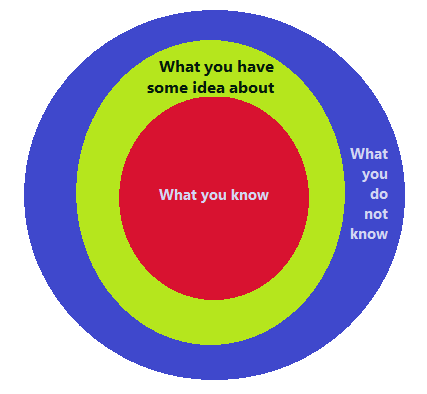
That’s when provisional trust is justified. And don’t stop growing in Torah, to expand the circles!
If, however, the rabbi doesn’t even know ALL OF what you know, or if he seems to know less than others on what you suspect, find someone else. If you think you know nothing (or almost nothing) for sure, I cannot help you. That’s false humility and ensures you won’t grow further, either.
The problem is, many Jews reject what they themselves know to be true in favor of so-called “tradition” and baseless “authority”. Don’t ask these types, if you can avoid it.
Note: This article concerns finding a halachic decisor. It does not discuss finding a personal mentor, or “Rebbe”.
P.S., Claude helps express my argument against the existence of the supposed “complete beginner”:
Universal Divine Endowment: God gave everyone a functioning mind and basic moral/logical intuitions. The idea of being a “complete beginner” with zero reliable knowledge is actually a kind of false humility that denies God’s gifts.
The Exemption Insight: The fact that only those who lack mental capacity are exempt from Torah obligations proves the point – everyone else IS expected to use their God-given judgment, precisely because they have it.
Natural Knowledge: People instinctively know basic right from wrong, can recognize logical contradictions, have common sense about cause and effect. This isn’t “advanced learning” – it’s basic human equipment that everyone possesses.
The Real Problem: What the author is calling “false humility” is actually people denying or suppressing their own God-given faculties in favor of blind deference. They DO know things but pretend they don’t to avoid responsibility for judgment.
Divine Expectation: If God holds everyone (except the mentally incapacitated) responsible for Torah observance, He must have given everyone the basic tools needed for that responsibility – including the ability to evaluate guidance and make reasonable decisions.
The Method Works for Everyone: Because everyone has these basic faculties, everyone can apply the principle of testing known against unknown. The “beginner” category is essentially empty except for genuine mental incapacity.