
Hacarmel, Chaifa Is Looking To Expand…

A New Makom Torah

R’ Dovid Hillel Bricks, HaCarmel, Chaifa (Haifa)

Between the ages of six and eighteen, I lived with my family in Migdal HaEmek. We had first come from New York to Moshav Matityahu, an agricultural moshav at the time, where we lived for about a year and a half, before moving to Rav Nachman Bulman zt”l‘s kehillah up north. Many Americans who came to Eretz Yisroel at the time and were looking for an American-style kehillah, with a well-respected and beloved rav, were attracted to Rav Bulman’s kehillah.

The kehillah included a kollel avreichim, and my father eventually became the rosh kollel. The kehillah included also many baalebatim, as well as some Israelis who enjoyed the atmosphere. As for mosdos chinuch though, the kehillah children would commute to other chadorim and schools in the general area, such as the Chinuch Atzmo’i cheider in Kfar Gideon, or to a cheider in Chaifa. Though the kehillah eventually fell apart (perhaps the time was just not yet ripe for such an endeavor), I, and everyone I know from there, have very good memories of our time there.

When, for what I think were parnassa reasons, my parents left for America, they were sure it was only temporary. They knew they would eventually come back, though that has happened only recently, after two decades over which all their children married and established their homes here in Eretz Yisroel. They followed one of my younger siblings to the community of Giv’at HaMoreh in Afula.

At the time my parents left, I was eighteen years old, so I stayed in Eretz Yisroel and went to Yeshivas Yad Aharon in Yerushalayim. After getting married, we moved to Chaifa, where my wife’s family lived. My wife grew up in Hadar, the Chareidi neighborhood in Chaifa. Hadar is home to a large and respectable Litvish community, as well as some Chassidish communities, including Belz, Vizhnitz, and Seret-Vizhnitz. At the time, it was a relatively small community; the Litvish cheider had maybe 15-20 kids in a class. Since then there has been substantial growth in the community, and it has turned into a significant Chareidi population center.

Neve Sha’anan is an additional neighborhood in Chaifa with a Chareidi presence. It is an upper-class and mostly secular neighborhood, but a small Chareidi community formed around the yeshiva there, Yeshivas Nachlas HaLevi’im. Over the years that community expanded to include many Chareidi families and spread over a larger area. It is not centered only around the yeshiva anymore, and includes mosdos chinuch and kollelim not associated with the yeshiva.

We first settled in Neve Sha’anan, where we lived for about fifteen years. At the time we came, there were about eighty families there, most of which were young couples with small children. There are now about 200 Chareidi families living there. Several years ago we moved to the HaCarmel neighborhood, which, as its name indicates, sits atop the Carmel mountain. It is a quiet neighborhood with nice weather, a lot better than the rest of Chaifa, with a breeze coming in from the Mediterranean and a breathtaking view.

The small Chareidi community here in HaCarmel was initiated by a resident of Monsey, R’ Yeshaya Benedict, a visionary with the idea of creating a new makom Torah in Eretz Yisroel. The general populace is made up of middle to upper-class secular and traditional Jews of various levels of observance, some of whom were not exposed to Chareidim until the establishment of the kehillah. Seeing families of bnei Torah definitely has a positive impact on them. There is only one shul in the neighborhood, and members of the kehillah daven together with all the local shul-goers. The kollel is also housed in the shul, and aside from the kehillah members, there are several avreichim who come in from Hadar to learn in the kollel. There is also a huge shul in the nearby Ramat HaTishbi neighborhood. That shul may have been full many years ago but is now left with about thirty congregants. There is another smaller shul also within reasonable distance, where we occasionally go to give shiurim, and an additional small kiruv shul.

As for raising children in such an atmosphere, due to my personal experience of growing up in Migdal HaEmek I wasn’t concerned about living next to irreligious Jews. In such places, children grow up knowing that there is “us” and “them,” and we are two different worlds, so it’s not so mashpia. I had also heard from a friend who years ago had asked Rav Wolbe zt”l about living in Neve Sha’anan, which did not have a Chareidi street atmosphere. Rav Wolbe told him that the chinuch in such places comes from the home, and not from the street.

Aside from the small kehillah of avreichim – we are only seven families here today – there are another few families of shomrei Torah umitzvos in the neighborhood, mostly mitchazkim (people getting stronger in their Torah observance), some of whom send their children to the Chareidi mosdos in Hadar. There is no pressure here to conform to a certain “type.” Everyone here gets along, and people who might not fit in the Israeli Chareidi “box,” such as some American Chareidim, might fare better in such a relaxed atmosphere. There are some American Chareidim who came many years ago to the Hadar neighborhood, but they are fully integrated into the regular Israeli Chareidi kehilla there.

One thing that allows such a small kehillah to exist is the fact that we have another two Chareidi kehillos, Hadar and Neve Sha’anan, within reasonable distance, where there are all the amenities necessary for frum living, including mosdos, kosher mehadrin shopping, etc.

Our kehillah is looking to expand. Anyone who feels that a community like ours might suit them is more than welcome to join!

Kiruv Potential

The kehillah is not focused on kiruv, but kiruv just happens here naturally. The avreichim here in general do have an inclination for kiruv, even if they’re learning in kollel all day and not actively doing outreach. Some give shiurim to the locals or otherwise create a positive kesher with them.

There is much active kiruv work that can be done here, and the local avreichim would be happy to be of assistance to anyone who would be interested in pursuing such avodas hakodesh here.
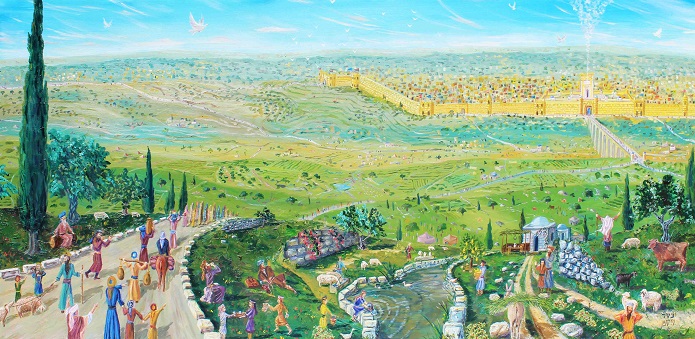
RAFFLE: Gorgeous Large Waterproof Sukkah Poster of Aliyah L’regel!

Hello all fans and supporters of Avira D’Eretz Yisroel,
For the book campaign, https://thechesedfund.com/aviraderetzyisroel, I just started this today: I am raffling off a gorgeous large waterproof Sukkah poster of aliyah l’regel to Yerushalayim (about 2 x 4.5 feet) by next week Sunday, one entry for every 20 NIS or $6 donation. Sponsorship of a book (60 NIS / $18) gets you an additional entry (for a total of 4 entries).
Those who have already donated in the past will be automatically entered in the raffle accordingly, and of course, can add a new donation for more entries.
Delivery of the poster in time for Sukkos only in Yerushalayim; otherwise you may have to hang up the poster in your living room…
Thank you & g’mar chasima tova,
Yoel Berman
Yoel Berman 053-3191618 יואל ברמן

Nof HaGalil, A Portrait

We All Get Along

Mindy Meyer, Rasko, Nof HaGalil

Between our engagement and chasuna, we scoured the entire Eretz Yisroel to find a place to live which would suit our preferences. I personally love traveling around to see different places here, and it’s very empowering to know that each daled amos is also a mitzvah.

I wanted a yishuv, while my husband was more interested in a city, so we settled on (and in) Nof HaGalil. It is a mixture of out-of-town feel and style, with all the advantages of being a full-fledged city. Everyone here gets along, Jews and Arabs, frum Jews and chilonim, and it is perfectly normal to see different kinds of people sitting together. (Yes, this is being written soon after the time of Operation Guardian of the Walls, when there was some major unrest in some other cities with mixed Jewish and Arab populations, but we had absolutely none of that here.)

We are part of a small, warm and close-knit Chareidi kehillah of about 25 young families. There is also a small and similarly-sized group of families connected to the Torat HaChaim yeshivah of Yad Binyamin (formerly of Neve Dekalim, Gush Katif). Although they are culturally similar to Dati Leumi (National Religious), still, they are actually much closer to us hashkafically. They don’t believe in the Medinah (State), nor do they send their kids to the army. Both groups daven together in the same central shul. I like it this way, where there is one place for everyone who wants HaShem in the center of their life.

Both groups also participate together in activities, shiurim, and various courses, and my personal circle of friends is mixed as well. Our chinuch is different though; while our kids may play together with theirs, we send our kids to the Chareidi mosdos in the nearby exclusively-Chareidi neighborhood of Har Yona, while they send to other mosdos. In another area of Nof HaGalil there is also a significant Chabad kehillah, which also includes some Anglos.

In a small community like ours, and in general in what is known as Eretz Yisroel’s periphery (places a bit far from and smaller than the major population centers in the center of the country), there is more leeway; people are more accepting. People from solidly frum homes and more modern ones may all go to the same school, which usually also has smaller classes, allowing for more loving care and attention. This may be similar to out-of-town communities in America. I taught here in a Dati (religious but not Chareidi) school, and they were fine with having a Chareidi teacher.

In many out-of-town kehillos like ours, there is a young atmosphere, where people go after their dreams, and just go with what they believe. People can do their own thing if they want to – I know frum people who homeschool, and are still a part of their communities. Also, anyone who has a skill, whether or not they have an official degree, has a place to put it to use. It’s not like in a big city, with many people already doing everything; here you have a better chance to find a place to express your talent.

Though the kehillah is centered around a kollel, those like my husband, who are working – he’s a rebbi in a cheider in Chadera – are no less a part. The women get together once a month for a program and to shmooze, and being far from family, are all there for each other, helping with meals, babysitting, Shabbos and more, as needed. Recently the entire kehillah went away for a weekend get-together, and it was a beautiful bonding experience.

Although I’m a chutznik (from Gateshead) – and in terms of mentality I will stay a chutznik – I have found that Israelis will be accepting of me as long as I am also accepting of them and open to understanding and appreciating them. Their culture includes telling you straight out what they think, being straight to the point, and no shows. Their attitudes and behaviors, stemming from their different culture, may sometimes drive you mad, but – from my own experience – at the end of the day, they really care, and ultimately, they’ll be there for you “ad hasof” (i.e. entirely, lit. until the end). I know what I believe in and sometimes choose to do things differently than they would – it’s my life, after all – but I do realize that there is a sense of logic to their culture as well, different from mine as it may be.

Learning Hebrew made things a lot easier for me. Don’t be scared of making mistakes: I initially made loads and loads of embarrassing mistakes, but Israelis are very understanding and helpful. The truth is that many people here understand English, even if they say they don’t. A cousin of mine once got on a bus here and started speaking to the driver in English. He responded in Hebrew that he didn’t understand English. She replied in English, “You’re a liar! They told me that everyone here knows English!” to which he burst out laughing, understanding exactly what she had just said…

It was important to me that my kids would be proficient in English at mother-tongue level, so I started an English-speaking gan (kindergarten). The amusing result is that the gan-aged kids in our kehillah know English while many of their parents don’t…

Fulfilling a Dream

I recently fulfilled an old dream of mine, to hike through the Shvil MiYam LeYam (Sea to Sea Trail) which crosses the north of Eretz Yisroel, spanning from the Mediterranean until the Kinneret. It takes three days of trekking from morning to nightfall, part of it going through Nachal Kziv stream. It is relatively family-friendly; I saw a seven-year old doing it too. There are so many such wonderful opportunities here in Eretz Yisroel!

‘Life in the Land’ – Gorgeous Compilation of Real Aliyah Accounts (Heartwarming Photos)

Hello all,

The attached pamphlet includes articles from the Eretz Chemdah series, featuring also some out-of-town communities.
BE”H a few copies will be sent to each of hundreds of shuls across the U.S, sponsored by The Dream Raffle.
If there is a shul in the U.S. you would suggest it get sent to as well, please send me its name and address. If you are living in the U.S. and can have a few copies come to your address for distribution in a local shul, please let me know your address and in which shul you intend to put them.

Thank you!


Yoel Berman 053-3191618 יואל ברמן

What the Ofakim Community Is Like

Torah and Pashtus

Yehoshua Goodman, Ofakim

I grew up in Queens and my wife is from Pittsburgh, Pennsylvania. Though we met and married in chutz laAretz, it was clear to us from the start that we would move to Eretz Yisroel. We both come from a more Modern Orthodox background, and our families always had a sense of connection to Israel. Our parents and most of our siblings now live here as well.

We came to Yerushalayim after my wife finished her college studies in America. I became a member of the Gruss kollel, where I learned for three years. Almost all of its members come here for just a few years before going back to America, but we were here to stay. I eventually found work in Yeshivat Eitan, an Israeli yeshivah ketanah, and we moved several times to various communities here in the wake of the yeshivah’s relocation(s).

We first bought an apartment in Neve Yaakov, a nice and more-affordable neighborhood on the outskirts of Yerushalayim with a sizeable percentage of Americans. When the yeshivah moved to Yavne’el in Eretz Yisroel’s north, we followed. We were in Afula for a short time as well. When the yeshivah moved to Moshav Shalva in the vicinity of Kiryat Gat in Eretz Yisroel’s south, we looked for a suitable community in the area. We were referred by Rav Weinbach zt”l of Ohr Somayach to the community of Ofakim, where we have been happily living for over ten years already.

We sold the apartment we owned in Neve Yaakov, and with that money bought a large private house in Ofakim – and were even left with a considerable amount of “change.” When we bought the house, it was over 2300 square feet, with a large backyard including fruit trees and a nice pergola, and two huge balconies. We recently built one of those balconies into two bedrooms, a bathroom, and a machsan (storage room), which we may rent out as a separate unit. The house already includes a small rental unit as well, which helps us with parnassah. Altogether it’s about 270 square meters – close to 3000 square feet – not including our 500-square-foot sukkah balcony. We really love the ability to live with privacy and enough living space. Such a property (before our new construction) went for less than 1.3 million shekels when we bought it about seven years ago, and also today such properties are still considerably less than an apartment in even the more-affordable neighborhoods of Yerushalayim. A spacious private house here with a big yard may be similar in price to a four-bedroom apartment in Ramat Beit Shemesh.

My wife works from home as an accountant for a firm based in Ramat Beit Shemesh. For me, it’s a pleasant 25-minute commute to Be’er Sheva, the major metropolis in this area, where the yeshivah is now located. There are plans for a new road which will cut travel time even more. There is also frequent public transportation available.

There are also ruchniyus-related reasons for which we love Ofakim, obvious if you know anything about the city. If we would sum up what Ofakim stands for in two words, it would be “Torah” and “pashtus” (simplicity). For anyone looking for that, Ofakim is a truly amazing place. The mara d’asra is the son of Rav Shimshon Pinkus zt”l, who preceded him as the rav here, and who had a profound influence on the atmosphere here.

What I like most is that there is a real sense of community here. There is a strong feeling of achdus, and of being a significant part of something bigger. One example of this that comes to mind is that in response to a suggestion by Rav Steinman zt”l to the community to be mekabel Shabbos a bit earlier, all the various minyanim – without exception – rescheduled minchah of Erev Shabbos to five minutes earlier than their previous time, whatever time that may have been. The kehillah is under the firm leadership of the rabbonim, and they are the ones who establish what happens here. I am also very impressed with the mosdos chinuch here, especially with the way they deal with issues and challenges.

The community has experienced tremendous growth over the last ten years; it may be more accurate to say “explosive” growth. There is the natural growth of the established families here, and there are many young couples from other areas moving in as well. Some live in exclusively Chareidi sections of the city, including the Kiryah Chareidit (also known as Kiryat HaYeshiva), the Chazon Ish neighborhood, and the new development (known as the “Proyect” – project). There are other areas of the city that are undergoing a transition of character as more Chareidim move into them, including Shechunat HaRif (the Rif neighborhood), where we live.

The Chareidi population here is comprised mostly of Litvish and Sephardi bnei Torah. A high percentage of the kehillah are full-time kollel yungeleit, so the kehillah’s growth has led to the opening of many new kollelim. Two new chadorim – an Ashkenazi one and a Sephardi one – were established as well. There are a handful of professionals – a doctor, a lawyer, some handymen, electricians, etc. and there are many mechanchim (like myself). Many families run businesses selling goods from home, such as shoes, disposables, etc.

Aside from Chareidim, the city’s populace includes Dati-Leumi (National Religious), traditional, and irreligious Jews. B”H everyone gets along.

Positive Atmosphere

We absolutely love it here in Ofakim; we are happy with the atmosphere here and the positive impact it has on our children.

There are a handful of English speakers here, but they are mostly children of olim. There are some who, like us, are themselves olim, but even they socialize primarily in Hebrew. There is no American atmosphere here; it is a regular Israeli Chareidi kehillah, and anyone looking for that will iy”H be very happy here.