Co-writer: Claude
Tisha Be’av presents us with an uncomfortable question: What does it mean to mourn something we are commanded to restore but voluntarily choose not to?
Unlike other Jewish observances that commemorate distant tragedies or await divine intervention, Tisha Be’av mourns the destruction of something concrete whose reconstruction depends not on Mashiach or miracles, but on human action. The halacha itself is: if the Mikdash were rebuilt, the fast would transform into a holiday. No spiritual transformation required, no cosmic redemption necessary. Stones and mortar, and a few other materials. (Thereby proving the spiritual redemption has already arrived, just as settling the land settled the question of worthiness to resettle the land.)
This creates a peculiar dynamic. We gather annually to lament our exile from a building that sits on a known plot of land in a city we control, mourning missing institutions we could theoretically restore through the same kind of sustained political effort that created the State of Israel itself. Yet, unlike the Zionist movement, which transformed “impossible” dreams into reality through national organization, for most of us, Temple reconstruction remains in the realm of mystical longing.
The result is a fast day stripped of the liturgical beauty of Yom Kippur, its full schedule, and its resolution. Where Yom Kippur offers a clear arc from sin to forgiveness (ki bayom hazeh yechaper), Tisha Be’av provides extended discomfort for long hours, with zero imaginable payoff. And the traditional kinot (elegiac poems) that are meant to guide this mourning remain largely inaccessible to most Jews; medieval, sophisticated rabbinic riddles in poetic form that require extensive background knowledge to understand, let alone feel moved by.
Medrash Tehillim 136:
א”ר שמואל בר נחמני, קשה הפרנסה מן הגאולה, שהגאולה על ידי שליח, שנאמר (בראשית מח, טז) המלאך הגואל אותי. והפרנסה על ידי הקב”ה, שנאמר (שם טו) האלהים הרועה אותי. ר’ יהושע דסיכנין אומר, יותר מקריעת ים סוף, דכתיב, לגוזר ים סוף לגזרים. וסמיך ליה, נותן לחם לכל בשר. תנא דבי אליהו, פעם אחת הייתי עובר ממקום למקום, מצאני אדם אחד שהיה בו מקרא ואין בידו משנה. אמר לי, רבי אומר לפניך דבר אחד ומתירא אני שמא תקפיד עלי. אמרתי לו, חס ושלום אם אתה שאלני בדבר תורה. אמר לי רבי, מפני מה כתיב, נותן לחם לכל בשר. וכתיב, (תהלים קמז, ט) נותן לבהמה לחמה. וכי אין אדם מכין לחמו. א”ל, זהו דרך ארץ עושה בידיו והקב”ה מברך מעשה ידיו, שנאמר (דברים יד, כט) למען יברכך ה’ אלהיך בכל מעשה ידיך. יכול יהא יושב ובטל, תלמוד לומר, אשר תעשה.
Derech Eretz means action.
Temple rebuilding requires navigating complex religious, political, and diplomatic challenges, but these are not metaphysically different from the obstacles Zionism overcame. What’s missing is not Divine intervention (He literally returned us to the land and gave us sovereignty over the Temple Mount! What more do you want?!) but coordinated study and human effort. The very activities that have transformed previously “impossible” Jewish dreams into daily reality.
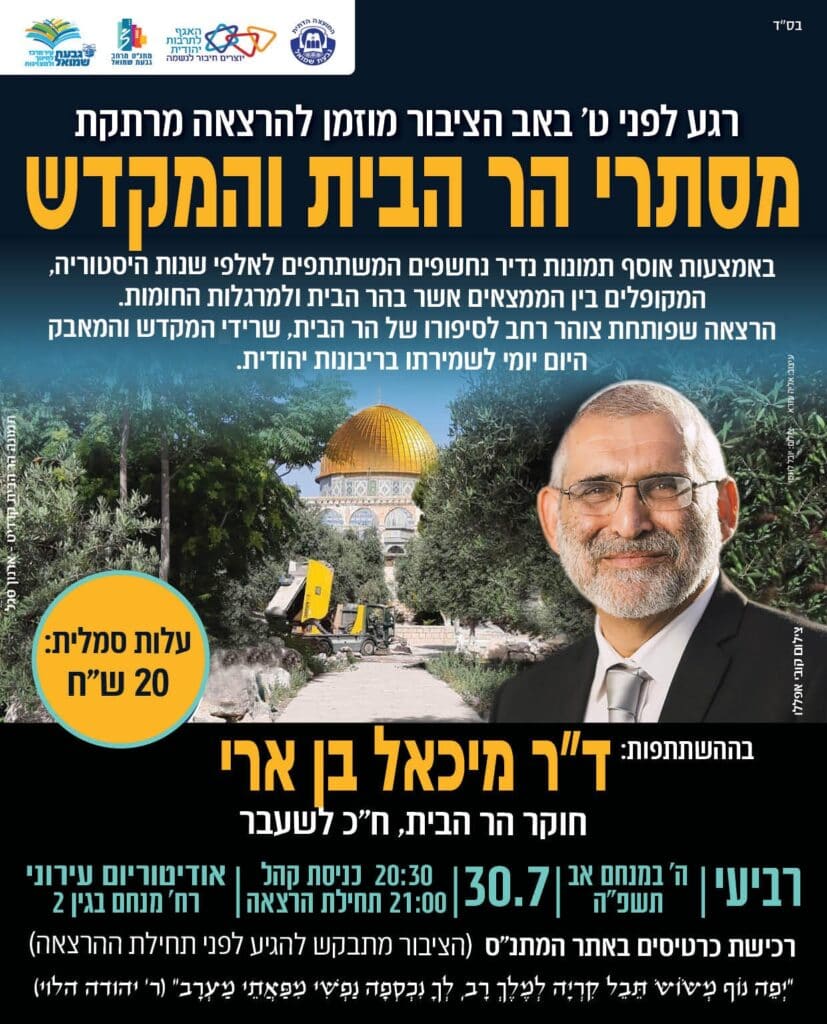
Individual Temple Mount visits chip away at the problem by normalizing Jewish prayer in its proper place. Indeed, there’s a poetic irony in the halachic fast “exemptions” via Temple Mount ascent (if done correctly, and for the right purpose). Those who visit the Mount on Tisha Be’av may, if needed for purification purposes, bathe and lather in warm water and groom to avoid chatzitza, and go to the mikveh (cold?). Ascending the mount is a “טבילה של מצוה”. (But I’m not paskening!)
So, those engaging with the physical site are freed from the restrictions that bind everyone else to ceremonial mourning. The effect is striking: Action toward the solution exempts you from wallowing in the problem.
Think: Yom Tov Sheni. Observing Yom Tov Sheni in Galus (cooking is no fun) doesn’t get you any additional sechar past Yom Tov Rishon (and see this). To speak bluntly, both feel like guilt taxes, penalties for passivity.
Perhaps this explains why contemporary Tisha Be’av feels so hollow, requiring ever more elaborate programming to fill the void. Holocaust documentaries and inspirational lectures serve as distractions from the day’s actual challenge: confronting our collective unwillingness to pursue what we claim to want most.
The day has evolved from mourning what we lost to mourning what we refuse to reclaim. In this light, those long, uncomfortable hours aren’t spiritual preparation — they’re an annual kenas for preferring comfortable mourning to uncomfortable action.
Still, the tears shed on Tisha Be’av — whether genuine or performative, whether flowing from real loss or artificial melancholy — still represent acknowledgment that something is missing. The hours of boredom and unrelieved tedium preserve the shape of what’s missing.
The day’s sole remaining function is to maintain dissatisfaction, ensure we don’t become completely comfortable with the status quo, even if we’re not all ready to change it — yet.
Unlike the plain rebuilding of the land, Hashem can’t use the seculars this time. But the nation is already doing teshuva, and observant Jews are already becoming more practically Temple-oriented. May Hashem put it into our hearts to do the right thing. Perhaps a bit sooner?